Friday, June 13, 2008

Tribute to Tim Russert:Sunday Morning Tim Russert Academy of Public Affairs


            Tim Russert (1950 - 2008)


I haven’t missed Meet the Press in 12 years. After Mass it is an essential part of my Sunday morning ritual. I am listening to MSNBC’s ongoing coverage of Tim Russert’s sudden death today, June 13, as I am working. I have this great sense of loss, as if a family member has suddenly gone to heaven without warning.


Tim Russert’s passing has touched me deeply. As a Daughter of St. Paul, with our mission of evangelization with communications media, I have had an enduring interest in discovering integrity in journalism, and civility. Tim Russert lived these values.


The 1971 Vatican document Communio et progressio spoke about the necessity for people to have access to information so that they can take an active part in democracy:


“If public opinion is to be formed in a proper manner, it is necessary that, right from the start, the public be given free access both to the sources and channels of information and be allowed freely to express its own views. Freedom of opinion and the right to be informed go hand in hand.” (para. 33) http://www.vatican.va/roman_curia/pontifical_councils/pccs/documents/rc_pc_pccs_doc_23051971_communio_en.html)


Tim’s journalistic style seemed to have been framed by this teaching because he went after truth, transparency, and accountability in those in public service and/or the public forum.


As Andrea Mitchell said today, on MSNBC’c coverage of Tim Russert’s death, “Tim set the gold standard” for political journalism and analysis as the moderator of Meet the Press and NBC’s Washington Bureau Chief. Peggy Noonan, and others, commented beautifully on how Tim was a Catholic in the public forum with obvious joy – and without apology. I think it was Howard Feinman of Newsweek that said that if he ever thought of becoming a Catholic, Tim Russert would be the one he would follow into the Church. Cardinal John Foley, with whom Tim and his family had lunch a few days ago in Rome, concurred with the above and more.


Someone just called Tim “the great explanator.” Senator Joe Libermann called him “The explainer-in-chief.” With so much facility, and with dogged persistence, he got the facts and got at them for our information. He respected his guests but to the viewer’s benefit, he did not tolerate fools; he questioned them. What I most appreciated about Tim Russert’s style was that his show was not about him; he was not about his own celebrity. He let his guests speak and he drew them out. He challenged them with their own words but never “talked over” them like so many radio and television commentators do - to my great annoyance.


As a media education specialist I know that the news industry has agendas and perspectives, that ideology and ratings drive the business. So over my years at the Sunday Morning Tim Russert Academy of Public Affairs I tried out other Sunday morning news shows to compare them with Meet the Press, to make sure I was getting as complete a picture of our political reality as possible. But none reached the level of objectivity that Tim achieved. Even though Tim’s persistence or insistence that his guests pronounce on a hypothetical situation could sometimes push the limit, I think Tim’s integrity and professionalism ultimately won the day because he made people think. His technique of meaningful and civil inquiry taught me to think beyond the limits of information status quo. For Tim Russert there never was a status quo he couldn’t disturb.


A nun friend of mine sent me an email today saying, “Tim Russert was the best. Such an interviewer; a good man; a good Catholic.” 


A few years ago the Catholic Academy for Communication Arts Professionals honored Tim Russert with a Gabriel Award for Personal Achievement. You can see Tim’s acceptance speech in streaming video on www.CatholicAcademy.org where he talks about being a Catholic, meeting Pope John Paul II, and bringing The Today Show to the Vatican.


Tim Russert loved his family, his home town of Buffalo, New York, the Buffalo Bills, the nuns who taught him and his Catholic Jesuit education. How proud the Catholic community can be of this magnificent son. He has set the bar for people of good will everywhere who want to be political journalists. He was a mentor to his colleagues, a gentleman journalist who loved and lived his job with grace.  A role model for Catholics who want to make a difference and contribute to the common good. Information is power and Tim empowered us, the regular people out there, by pursuing truth. Above all, he was who he said he was. May it be the same for all of us.


Someone once said that a person doesn't die until they have nothing left to learn.


We offer our prayers for the repose of Tim's soul, and that the Lord may console his loved ones at this sad time.


Wednesday, June 4, 2008

Theology of Communication of John Paul II


John Paul II's Theology of Communication

Interview With Theologian Christine Anne Mugridge

By Carrie Gress

ROME, JUNE 3, 2008 (Zenit.org).- The theology of communication is not merely Christianizing media-technology or scientific techniques, but rather an encounter with the living Christ, says theologian Christine Anne Mugridge.

Mugridge, a lay member of the Society of Our Lady of the Trinity, is an author of "John Paul II: Development of a Theology of Communication." Salesian Sister Marie Gannon, professor at the Pontifical Salesian University and the Faculty of the Sciences of Education "Auxilium," provided research for the book.

The text was published by Libreria Editrice Vaticana in honor of the third anniversary of the death of Pope John Paul II.

In this interview with ZENIT, Mugridge discusses the seminal work of a theology of communication found in John Paul II's pontificate.

Q: In your book, you focused on teasing out John Paul II's theology of communication. Did he speak of this theology explicitly, or is this something you were able to discover among his many homilies, letters, audiences, etc?

Mugridge: John Paul II spoke in terms that were explicitly theological in nature regarding the topic of human-social communications and the media of communications, offering us through his almost 27-year-long pontificate a great wealth of commentary and texts addressing the topic.

While he himself did not state the goal to develop a specific theology, from a compilation of John Paul II's theological work it became evident from both the organic development and strategic employment of a theology of communication that a new theology has emerged -- that is, formulated, actuated and lived -- through his efforts.

This advancement is the focus of the curriculum text wherein we site these findings and highlight the theological touchstones that reveal a working theology of communication.

Q: Is a theology of communication merely using social communication techniques to spread the Christian message, or is there more to it?

Mugridge: There is quite a bit more to experience that is provided through the understanding and application of John Paul II's theology of communication; this is not a mere Christianizing of the media-technology or scientific technique.

First, John Paul recognized that the ethical conscience of people today is disoriented. The theology of communication recovers social communications, if you will, precisely at the point where the understanding and activity of communications is linked with the moral life of believers.

John Paul II teaches us through a theology of communication that we must first encounter the living Jesus Christ in order to enter into the mission of Christ. God revealed himself through communicative terminology -- "the Living Word" -- to not only describe what he is doing in his Revelation, but more importantly who he, God is.

As we encounter Jesus Christ -- we are illumined in our understanding of not only what we are doing, but who we are as communicating persons, that is, as human persons in communication with one another and with our Triune God. The foundational structure of this theology of communication begins with the gift of the presence of Jesus Christ, and "The Encounter with the Incarnate Word." This encounter is most personally fulfilled in the Eucharistic Presence.

As a result, the theology of communication is a tool formulated in a truly interdisciplinary manner that will assist the Church/Christian communicator in dialogue with the culture of the media and the mediated cultures of the world today. Likewise, it is not strictly an academic study; but rather according to the method in theology evidenced, we may experience it as an organic theological instrument to better understand both interpersonal and social communications specifically in relationship to the communication of Christ both inside and outside the Christian community.

This important development allows for the technological use of the media to be enhanced as well as provide for a key link/bridge to be strengthened between the moral and ethical perspectives of social communications from both the theological and secular sciences; thus granting the Church the opportunity to communicate her message in a more meaningful manner in her mission.

All of us in the Church by virtue of our baptism are called to live the mission of the communication of the Gospel; that is the mission to communicate Christ. Truthfully, this is not a matter of application of technique so much as it is a matter of first contemplating God's Revelation in the Incarnate Word.

Q: You cite "Ecclesia in America" as a significant document to understand this new theology. What was John Paul II trying to teach the world, and in particular, America, meaning a united South and North America, through this particular apostolic exhortation?

Mugridge: "Ecclesia in America" is cited as a sample text for its demonstration of the presence of a working theology of communication that is a hallmark of the pontificate of John Paul II.

"Ecclesia in America" is likewise exciting because in it John Paul both expands and concretizes our understanding of how all can live more deeply the Church's nature and mission through his communicative strategy for the New Evangelization defined as "The Encounter with the Living Jesus Christ."

John Paul II is trying to teach the world that in its nature, we may see the Church as the lived communion of man with the Most Holy Trinity, and in its mission, we see this communion being brought to the whole of humanity in and through the Church.

This missionary mandate is given a new impetus in our age through the Holy Father's teaching on the mission to communicate Christ as expressed in the New Evangelization. In particular, John Paul speaks of all America as being one united people both North and South. He places this people under the patronage of Our Lady of Guadalupe as the Star of the New Evangelization, Mother of Hope.

Finally, in "Ecclesia in America," John Paul II asks the people of America to embrace the call to the New Evangelization with open hearts. Pope Benedict providentially inspired America to live more profoundly this reality in his recent apostolic voyage wherein he encouraged Catholics to live their faith in union with one another in and through "Christ Our Hope."

Q: How should understanding the theology of communication change the way those involved with social media think about their work and/or themselves with regard to Christ and the Church's mission?

Mugridge: The understanding a theology of communication offers the transformative gift like any applied theological study. Specifically, it more fully reveals to man his providentially ordained communicative potential and the profound truth and nature of man's communicative reality.

The simple key of "The Encounter with the Living Jesus Christ" that John Paul developed in his communicative strategy for this mission of the Church is a gift that is easily comprehended and applied to personal and social, secular and ecclesial communication experiences -- thus transforming the members of the Church personally and corporately.

Understanding this theology gives both those involved with social media and those involved in the Church's mission the opportunity to experience personal, ongoing conversion wherein Christ becomes the living presence who reveals a model par excellence for all human communication activities.

The knowledge and application of this theological perspective of being necessarily impacts our daily lives. This theological awareness provides the foundational platform into which we then incorporate excellence in communications science principles, methodology, theory and management in all our communicative activities.

Q: Practically speaking, how can the "theology of communication" be applied to diocesan communication offices, seminaries, media outlets, etc.?

Mugridge: The Church, as noted, has a keen interest in the science of communication. So crucial is the role of public relations and communications that the Church requested formally that an office be established in each diocese for such an operation as well as the development of a diocesan plan of communications and for the development of a theology of communication.

From this interdisciplinary study, there emerge new horizons of convergent platforms for personal formation, interdisciplinary dialogue and pastoral initiatives providing for a meeting ground between the Church and the media, what Pope Benedict has urged -- a new type of "info-ethics."

The practical applications of a theology of communication within the Church are numerous and rich; in the formation of priests for their own personal/pastoral growth, for use in all diocesan offices regarding the development of communications planning, in media outlets for ongoing maturing of personnel to obtain a more profound and integrated understanding of their own communicative potential and so on. We offer ongoing education seminars to assist leaders in the Church to understand this theological development and to better use the textbook in their own particular milieu.

Q: Finally, why do you think this new theology is coming now, at the beginning of the third millennium?

Mugridge: In actuality, the foundational structure of this theology is not new, but is integral to the existing patrimony within the Church.

What is occurring now is the new awareness of both the need for and the presence of this theology of communication as well as the integral role that the media plays as a fundamental piece of the answer to the "anthropological question that is emerging as part of the key challenge of the third millennium" which Pope Benedict refers to in his World Communications Day message of 2008.

"Humanity today," Benedict explained, "is at a crossroads. [...] [S]o too in the sector of social communications there are essential dimensions of the human person and the truth concerning the human person coming into play. [...] For this reason it is essential that social communications should assiduously defend the person and fully respect human dignity. […] The new media […] are changing the very face of communication; perhaps this is a valuable opportunity to reshape it, to make more visible, as my venerable predecessor Pope John Paul II said, the essential and indispensable elements of the truth about the human person."

According to John Paul II, the means of social communications must become a way of communicating the fullness of the truth of man as revealed in Christ, for this is the only authentic foundation for solidarity and the realization of the integral development of all humanity according to the divinely ordained potential and dignity of the human person.

The application of this theology as a communicative strategy for the Mission of the Church is a crucial bridge to the "info-ethics" so needed in our day.

--- --- ---

On the Net:

"John Paul II: Development of a Theology of Communication": www.sacredartscommunications.org


For information on how to obtain a copy of this book, visit the publishing house of the Vatican at: www.libreriaeditricevaticana.com or

PaxBook.Com (distributing house for the Vatican)

HOME

Thursday, May 29, 2008

National Film Retreat - Register Today!


Date: Friday, July 4 – Sunday, July 6, 2008
(The deadline for registration is June 28, 2008)

Location: Pauline Center for Media Studies
3908 Sepulveda Blvd
Culver City , CA 90230
pcms@paulinemedia.com
Web site: www.NationalFilmRetreat.org

“No motion picture subgenre has had so perplexing a success as the food movie. Generally defined as an arty romance centered around elegant cuisine, the food movie jumped to success with 1987's Babette's Feast, and kept its audience through such acclaimed sleepers as Like Water For Chocolate (the 1992 adaptation of Laura Esquivel's novel) and 1996's Big Night (a tale of two restaurant-owning Italians whose brotherhood is united through their culinary art). More recently, big studios have tackled the food movie's commercial prospects, leaving us with the Oscar-nominated Chocolat (2000) and Simply Irresistible (1999), in which Sarah Michelle Gellar is transformed into a brilliant chef through the help of her magical pet crab. Where these films thrive is in their ability to make audiences wish they could be eating that which they're confined to looking at….” Mark Palermo, The Odd Success of the Food Movie


Film Slate

Friday evening
What’s Eating Gilbert Grape?


Saturday morning
Eat, Drink, Man, Woman

Saturday Afternoon
Optional Film or a contemplative walk along Venice Beach


Saturday Evening
Planes, Trains & Automobiles

Sunday Morning
What’s Cooking?


“THE MAGIC OF MOVIES AND THE SACRAMENTS . THE HOLY SPIRIT REVEALED IN CHALLENGING , SURPRISING AND DELIGHTFUL WAYS . CREATIVE INTERCHANGE . MUTUAL SUPPORT . IMAGINATIONS ON FIRE ! NOT BAD FOR A RETREAT . W HAT A GREAT EXPERIENCE !”
--REV . BOB BONNOT , DEEPER DIMENSIONS


For more information and to download the registration form, visit

www.nationalfilmretreat.org

Cruise Film Retreat Memo!

Cruise Film Retreat

       Join us for the very first


     Cathlic Film Retreat At Sea!


                    Theme:

       Melting Pots: Food & Family

Film Slate:

My Big Fat Greek Wedding, Big Night,

The Grapes of Wrath,

 What’s Cooking?


    Date: Friday, October 10 – Monday, October 13, 2008                                      

Long Beach, CA – Ensenada, Mexico – Long Beach, CA


SIGN UP TODAY!


Columbus Day weekend Prices:

Inside Quad cabins 3-4 people: $234.44 total

Inside double Cabins: $448.44 total

Oceanview Double Cabins: $488.44 total

includes donation to Daughters of St. Paul/Open Call/National Film Retreat; to be matched by Carnival,

film screenings & materials,

all port charges, taxes, and tips!

(no envelopes needed on last day!)


Optional Insurance: $39.00 per adult; $19.00 per child


Reserve your cabin at  www.ShareitTravel.com click on the group link in the upper right, then scroll down for Catholic Film Retreat, click the book it link at bottom

Or contact Ann-Marie Blaney by e-mail: blaneys@ShareitTravel.com

phone:  949-632-7155

direct link: http://www.yourtravelbiz.com/grouptravel/7W98L6.htm)

         Passengers must have a valid passport.

Film Directors:

Rev. Ron Schmidt, SJ, Hope Productions, Los Angeles

Sr. Rose Pacatte, FSP, Pauline Center for Media Studies, Los Angeles

Frank Frost, Frank Frost Productions, Washington, DC

Please call if you have any questions at all!


Retreat questions call: Nanciann Horvath 714-394-4989


Tuesday, May 27, 2008

Pope encourages media skepticism not cynicism

POPE-COMMUNICATIONS May-23-2008 (600 words) xxxi

Pope encourages media professors to teach skepticism, not cynicism

By Cindy Wooden
Catholic News Service
http://www.catholicnews.com/data/stories/cns/0802814.htm


VATICAN CITY (CNS) -- Students preparing for a career in communications must learn to be skeptical, especially when the public good is at stake, but they also must be helped to avoid becoming cynical, Pope Benedict XVI told communications professors.

"Nourish and reward that passion for truth and goodness that is always strong in the young. Help them give themselves fully to the search for truth," the pope said in a May 23 address to participants in a meeting sponsored by the Pontifical Council for Social Communications.

The meeting brought together professors and staff members from communications departments at Catholic universities and institutes from around the world to discuss the specifically Catholic mission of their educational programs, the best ways to respond to rapid changes in the field of communications and how to educate future media professionals in ethical values.

Pope Benedict told the professors that every form of communication -- from teaching to prayer -- using every means from the human voice to a computer is a reflection of the fact that human beings were created to communicate, to create relationships and to grow "in knowledge, wisdom and love."

Obviously, he said, if communication is to be effective it must be based on truth.

"A communicator can attempt to inform, to educate, to entertain, to convince, to comfort; but the final worth of any communication lies in its truthfulness," he said.

The "passion for truth" that communications students and professionals must have and develop "can be well served by a certain methodological skepticism, particularly in matters affecting the public interest," Pope Benedict said.

However, the pope said, students need guidance to ensure their questioning is not so distorted that it becomes "a relativistic cynicism in which all claims to truth and beauty are routinely rejected or ignored."

As mediabecome more and more important in people's daily lives, he said, helping people learn how to judge the ethical content they are accessing and teaching future professionals the necessity of always upholding the truth take on even greater urgency.

"It also is necessary to promote justice, solidarity and respect in every circumstance for the value and dignity of each person, who has a right not to be harmed in that which concerns his private life," the pope said.

Pope Benedict offered particular praise to the religious orders and bishops' conferences that have established Catholic universities in developing countries.

He said more attention must be paid to the fact that as new means of communications enable people to share information more quickly, millions of poor people have no access and are being left further and further behind the rest of the world economically and socially.

In addition, he said, communicators must be on guard against a form of global communications that "weakens or eliminates traditional customs and local cultures, especially those that have fortified family and social values, love, solidarity and respect for life."

In looking at the Catholic identity of the universities, Pope Benedict said that the percentage of Catholic students is not the point.

"It is most of all a question of conviction," he said. "Catholic identity lies first of all in the decision to entrust oneself -- intellect and will, mind and heart -- to God."

Those who study and teach communications are in a privileged place to help not only their students, but also their local churches to find more effective ways to proclaim the truth and "make known to all people the good news of the love of God," Pope Benedict said.

Saturday, May 24, 2008

Preaching the Media: Exploring Media, Faith & Values in Faith Communities

Preaching the Media: Exploring Media, Faith, and Values in Faith Communities (2008)


  People in faith communities are exposed to messages that may not agree with their own
    ideologies. How do these families reconcile the values in modern media with the religious
    values they believe in? This program provides a discussion with faith-based media
    educators about the impact of media, and how to educate children about the media at
    home and in the classroom.

    Includes interviews with Sister Rose Pacatte of the Pauline Center for Media Studies,
    Father Peter Malone of SIGNIS, and religious media scholars Maria Elena de las Carreras and Andrew Tinker.

    2008, 32 minutes, NTSC DVD

    This title is available for purchase.


http://carmelinafilms.com/preachingthemedia.htm

Thursday, May 15, 2008

Prince Caspian Review and Family Guide


The Chronicles of Narnia  Prince Caspian

A Family Film Guide


            1,300 years have passed in Narnia, though only one year has passed for the Pevensie children in Walden Media and Walt Disney Pictures latest production The Chronicle of Narnia: Prince Caspian. This interpretation of the fourth chronological volume of C. S. Lewis classic series (written 1950-1956) is literally roaring into theaters this week.


            The film opens with the birth of a child. This event causes Prince Caspian’s tutor, Professor Cornelius (Vincent Grass) to urge the teenaged Prince Caspian (Ben Barnes; Stardust), a Tamarine and heir to the throne, to flee the kingdom’s castle. His uncle, the usurper King Miraz (Sergio Castellito; Mostly Martha), wants to kill Caspian so his new-born son will one day reign. Cornelius gives Caspian the horn that had once belonged to Susan Pevensie (Anna Popplewell) and warns him to use it only in extreme necessity. 


            Caspian is injured and taken in by a kindly badger, Trufflehunter (Ken Scott; Charlie Wilson’s War) and the dark-spirited dwarf Nikabrik (Warwick David; Harry Potter and the Order of the Phoenix). With Miraz’s soldiers bearing down, Caspian blows the horn. It summons the Pevensie children from war-time London (1941) and lands them on a lush island in Narnia. They discover that since the children were last in Narnia, human Tamarines had invaded and exterminated most of the citizens. With the help of the good but grumpy dwarf Trumpkin (Peter Dinklage; The Station Agent) they journey to Aslan’s How where the Narnians have built a garrison at the broken Stone Table. Caspian meets them there. To help the oppressed Narnians and Caspian, the High King Peter (William Moseley) drafts a challenge to Miraz. The young people make decisions about war with dire consequences. Lucy (Georgie Henley) who thinks she has seen Aslan (voice of Liam Neeson; Batman Begins), seeks his help, only to discover that he has been there all the while.


The Film

            Director and co-writer Andrew Anderson has interpreted Prince Caspian through sweeping cinematography that is warm and beautiful. He has restructured the storyline while keeping the essence and key events of C.S. Lewis’ story in tact. By taking the time to develop the new characters in varying levels of complexity, this adaptation is non- linear, interesting and compelling. To their credit the writers have not reduced the moral dilemmas the characters face into simple black and white categories. Instead they show how difficult it is to know and choose what is right and good. The special effects are bold and magical. All the actors give solid, credible performances. The humor derives from the book and is well-placed, timed, and delivered.


Key differences between the film and the book are that the handsome Caspian becomes more of a central figure in the and there are too many prolonged chases and/or battle scenes. This has resulted in the film’s clocking in at almost 2 ½ hours – an hour too long for me.


            Yet Anderson has, in fact, turned Prince Caspian into a rather awesome, magical epic that is well worth experiencing. Aslan continues to be strong and gentle; Lucy’s relationship with him is genuinely affectionate, trusting, and confident. Lewis’ themes are subtly woven into the narrative and offer families and religious educators (and English teachers) much to talk about.


I think Prince Caspian is appropriate for children aged about nine and up because of the intensity of the fighting and violence (though completely bloodless). 
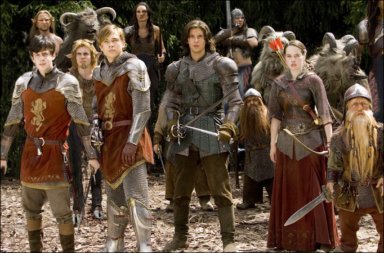
 

                                                     c. Disney  Enterprises Inc. and Walden Media LLC.
Photo Credit: Murray Close


Key Themes for Conversation


Faith, Hope & Love – The children discover a garden filled with apples. Lucy eats one of them. As the children and Trumpkin journey toward Aslan’s How, Lucy thinks she sees Aslan signaling them to take another route. The others don’t really believe her, and she doubts herself. Instead of following Aslan, she keeps going with the group. (What test of faith in the Bible do the fruit and the garden remind you of? See Genesis 2, 3). Talk about Lucy’s test and journey of faith, as well as that of the other characters. How did you feel when Lucy talks to Aslan about believing in what we cannot see? How did you feel about Aslan’s response to her? How did you feel when Nikabrik called upon the White Witch? What saved Peter from the temptation to trust her instead of Aslan’s promise?


What does hope mean to you? How did the Narnians, in particular, show hope in the film? Did they ever sound discouraged in having to wait so long for deliverance? What changed their sadness to hope? When Lucy asks Aslan why things cannot be as they were, what does Aslan tell her? What does he mean? How is Aslan the fulfillment of Lucy’s hope?


How many different kinds of love are shown in the film? Even though the Pevensie children don’t always agree with one another, do you think they love one another? How do you know? What kind of love does Caspian show for the professor? And the professor for him? What kind of love does Trufflehunter show? Who does King Miraz love? How do you know this? How did you feel when the heroic Narnians die at the castle? Why did they follow King Peter and Prince Caspian into battle? Why did the contents of Lucy’s bottle have the power to heal? Why is healing or helping others a sign of love?


Imagination -

What do you think is the difference between “seeing” and “looking”? Why do you think the characters talk about having “an imagination”? Why didn’t they all see Aslan when Lucy could? Aslan is often interpreted as a God-figure (as well as a Christ-figure) in C. S. Lewis’ Chronicles of Narnia. How do you imagine God to be? What does God look like to you? How do you talk to God in your heart? Is it like the way that Lucy talks to Aslan? (Would you like to try it? Close your eyes for a moment and pretend ...) 


Choosing Peace  – In the film Lucy offers a challenge to Peter and the others as they try to decide whether to pitch the battle at the castle or at Aslan’s How. She says that they are only considering two options: if they will die at the castle or at the How. What is the third option Lucy suggests to them? Do you think Lucy’s option would work in the world today? Why or why not? How does your imagination tell you the story would change if the children had taken Lucy’s suggestion?


Character or moral fiber – To have a good character means that a person makes right choices when alone or with others. Some of the funniest and most memorable moments in the film are when the characters make remarks about the personalities of the others. What qualities or virtues (habits of doing good), or negative traits did you notice in the film? (Courage, courtesy, chivalry, kindness, hospitality. love; lying, complaining, stubbornness, misuse of power.)  What did Reepicheep mean when he talked about his “huge humility”? Why do you think some people would think this was a funny thing to say? What did Aslan say about this? Do you think Prince Caspian was humble? What about Lucy and the other children and characters? Why? (Make a list of your favorite and another of your least favorite characters. Write one word beside each name that describes their character, that is, their virtues or character weaknesses.) What was the difference between Lord Sopespian and General Glozelle? Who said that no one can hate like humans can? Why did he say this? What is power? Why do some of the characters in the film want to be powerful over others and get rid of them? Is it ever right to want to bein power over others? Why or why not?


Decision making – Good character often is shown when people (or characters ina story) have to make choices between one, two or more things that may seem to have thesame importance. Upon reflection, however, a person will hopefully make the best choice for the common good of family, school, community, church and society based on what he or she knows to be right or wrong. If the person doesn’t know, he/she can ask for advice. Talk about when this happens in the film especially as it relates to resolving conflicts or arguments. Then, what decision(s) proves that Prince Caspian has a good, even great, character? What traits will make him a good leader? What would you have done in Caspian’s place when he has a chance to take revenge on King Miraz for his father’s death? What did Miraz do that was wrong? Why did he do that? Why is vengeance never a Christ-like option? (Do you think Azlan would have ever taken vengeance when he was slain in The Lion, the Witch and the Wardrobe? Why? What about the Pevensie siblings reacted when they find out who will be returning to Narnia and who will not? What character strengths did they show?


The Environment – Why are the trees dead in the film? What brings them back to life? What parts of nature are shown to be healthy in the film? What parts seem unhealthy? Do you think there is a message in the film about taking care of the earth? If you do, talk about what you noticed. (Why is it a good thing to care for the earth?)


Other themes in The Chronicles of Narnia: Prince Caspian: Myth; the hero’s journey; moral issues such as murder and the existential/spiritual and physical effects of such unnatural acts; gender roles; multiculturalism; growing up; spiritual maturity; racism and genocide; freedom from oppression; key themes of Catholic social teaching  as reflected in the film (http://www.usccb.org/sdwp/projects/socialteaching/excerpt.shtml); symbolism: light, water, etc.; sacramental signs and their meaning.


__

__________

Sister Rose Pacatte, FSP, is a Daughter of St. Paul and the Director of the Pauline Center for Media Studies in Culver City. She is the film/TV columnist for St. Anthony Messenger and a contributor to The Tidings. Sr. Rose is also a media literacy education specialist. www.PaulineCMS.org